Your Calendar Ate Lunch. Here’s How to Take the Hour Back
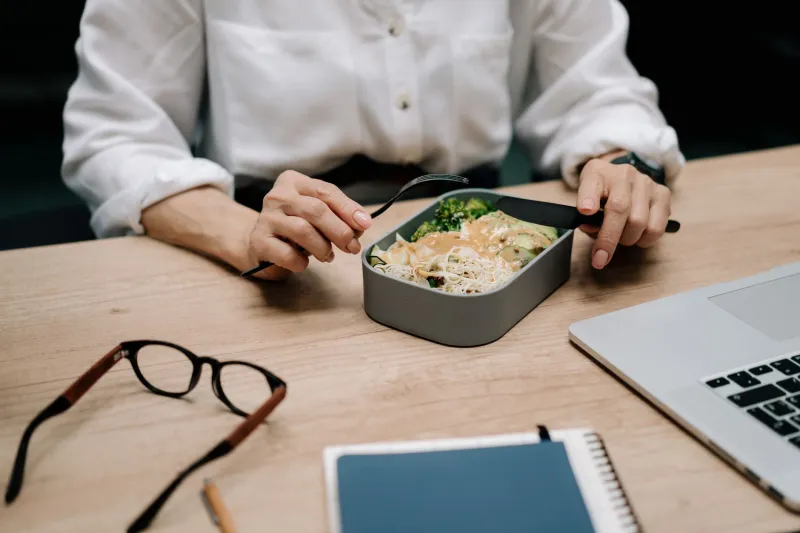
There is a particular kind of defeat in eating a sandwich at 2:47pm while replying to a thread that should have been an email. You are not hungry any more. You are not full either. You are just aware that lunch happened to you rather than for you.
The lunch hour has become the office’s most polite casualty. It did not disappear in one dramatic act. It got nibbled to death by 30-minute invites, quick syncs, and the quiet belief that if you are at your desk you are available. In UK offices we are remarkably good at treating a break as a favour rather than maintenance. This is an argument for taking it back — not with a grand gesture, but with a calendar block and a slightly stubborn script.
How the hour disappeared
Open your calendar for a normal week. Somewhere between 12 and 2 there will be a meeting called something like 'quick touchpoint' or 'working lunch'. Neither is quick and neither involves lunch. Then there is the commute-to-the-kitchen tax, the queue at Pret, and the bit where you eat while scrolling through emails because leaving your desk for 40 minutes feels like a confession.
No one is doing this maliciously. Most 12pm meetings are booked because the person booking them is also busy and that was the only gap. But if you never push back, the gap becomes a permanent slot. The lunch hour is not a meeting slot. It is the bit of the day that makes the rest of the day possible.
The rule: eat, move, reset
You do not need a perfect hour. You need a structure. Try this: eat for 20 to 25 minutes away from your screen. Move for 10 to 15 minutes — walk round the block, take the stairs, stand outside. Reset for five minutes — fill your water bottle, look at your afternoon, write down the one thing you need to finish. That is 30 to 45 minutes, and it feels like a proper break because it has a beginning, a middle and an end.
A 30-minute lunch can work. What does not work is a 30-minute lunch spent at your desk with a laptop open and a fork in one hand. That is not a break; that is eating in a meeting.
Scripts for the 12pm ambush
Declining a meeting is awkward, so borrow a line. Keep it boring and polite. 'I am not available at 12 — can we do 1:15?' is a complete sentence and needs no apology. If you need a reason: 'I have a standing lunch break.' If it is a recurring meeting: 'I keep 12 to 1 free as a no-meeting window. Happy to move our call to 1:15.'
For a boss or client, use outcomes rather than rights. 'I have noticed my afternoons are sharper when I take a proper break. Can we shift this to 1?' That is harder to argue with than 'I want lunch.' If you are worried about being seen as difficult, remember that no one has ever been promoted for eating a sandwich while typing.
Small changes that make 30 minutes count
Block lunch in your calendar as a recurring event. Give it a name that people can see: Lunch. Set your status to away if your workplace uses one. It feels absurd to schedule a break, but it is less absurd than never taking one.
Eat away from your desk, even if it is just the canteen or a bench outside. The change of location matters more than the food. If you bring lunch in, make it something you can assemble in five minutes so the break is not spent queueing. Pair lunch with a short walk, even a lap of the block. Do not take your phone. Ten minutes without a screen feels longer than an hour with one.
And protect one day properly. If every day is impossible, pick Tuesday or Thursday and make it the day you leave the building. A single reliable break can change the shape of the week.
The hill to die on
The lunch hour is not a luxury or a personality quirk. It is a basic part of a working day. You do not have to be dramatic about it. You do not have to lecture anyone about wellbeing. You just have to stop treating 12pm as free real estate. Take the hour back, politely but firmly. The emails will still be there at 2. You will be better at answering them.